Noun classes
From wikipedia
a noun class is a particular category of nouns. A noun may belong to a given class because of the characteristic features of its referent, such as gender, animacy, shape, but such designations are often clearly conventional. [...]
Noun classes form a system of grammatical agreement.
Example from the same wikipedia page
Modern English expresses noun classes through the third person singular personal pronouns he (male person), she (female person), and it (object, abstraction, or animal), and their other inflected forms. Countable and uncountable nouns are distinguished by the choice of many/much. The choice between the relative pronoun who (persons) and which (non-persons) may also be considered a form of agreement with a semantic noun class. A few nouns also exhibit vestigial noun classes, such as stewardess, where the suffix -ess added to steward denotes a female person. This type of noun affixation is not very frequent in English, but quite common in languages which have the true grammatical gender.
Adding a noun class
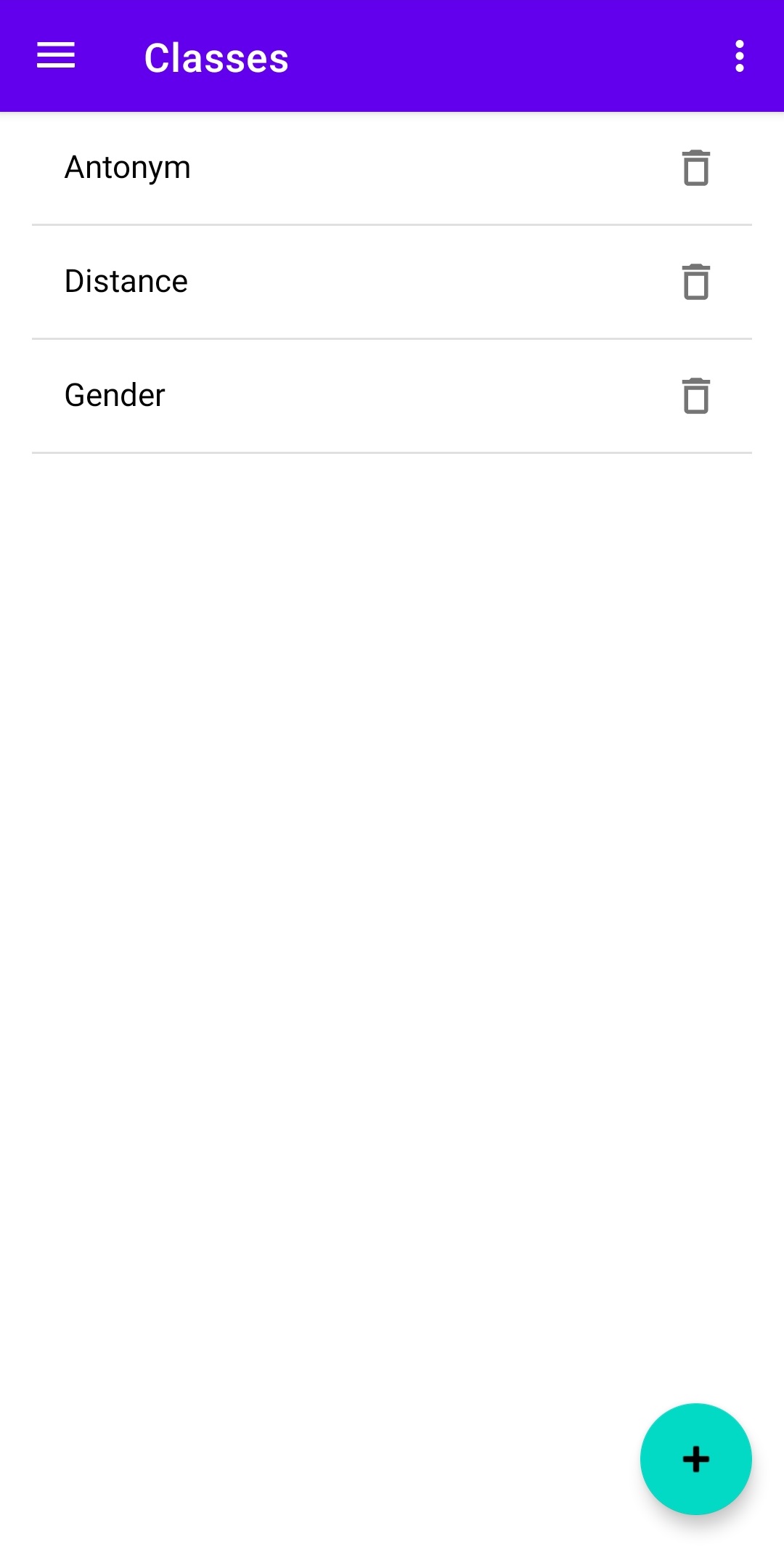
In the bottom right corner you'll find the "+" button to add a class to your conlang.
When you click it you'll be taken to the class info screen, where you'll be able to add the information about the class.
Editing an existing noun class
Once you have a class listed in for your conlang, you'll be able to click on it to open the class info screen to manage its properties.
Class info screen
Class properties
-
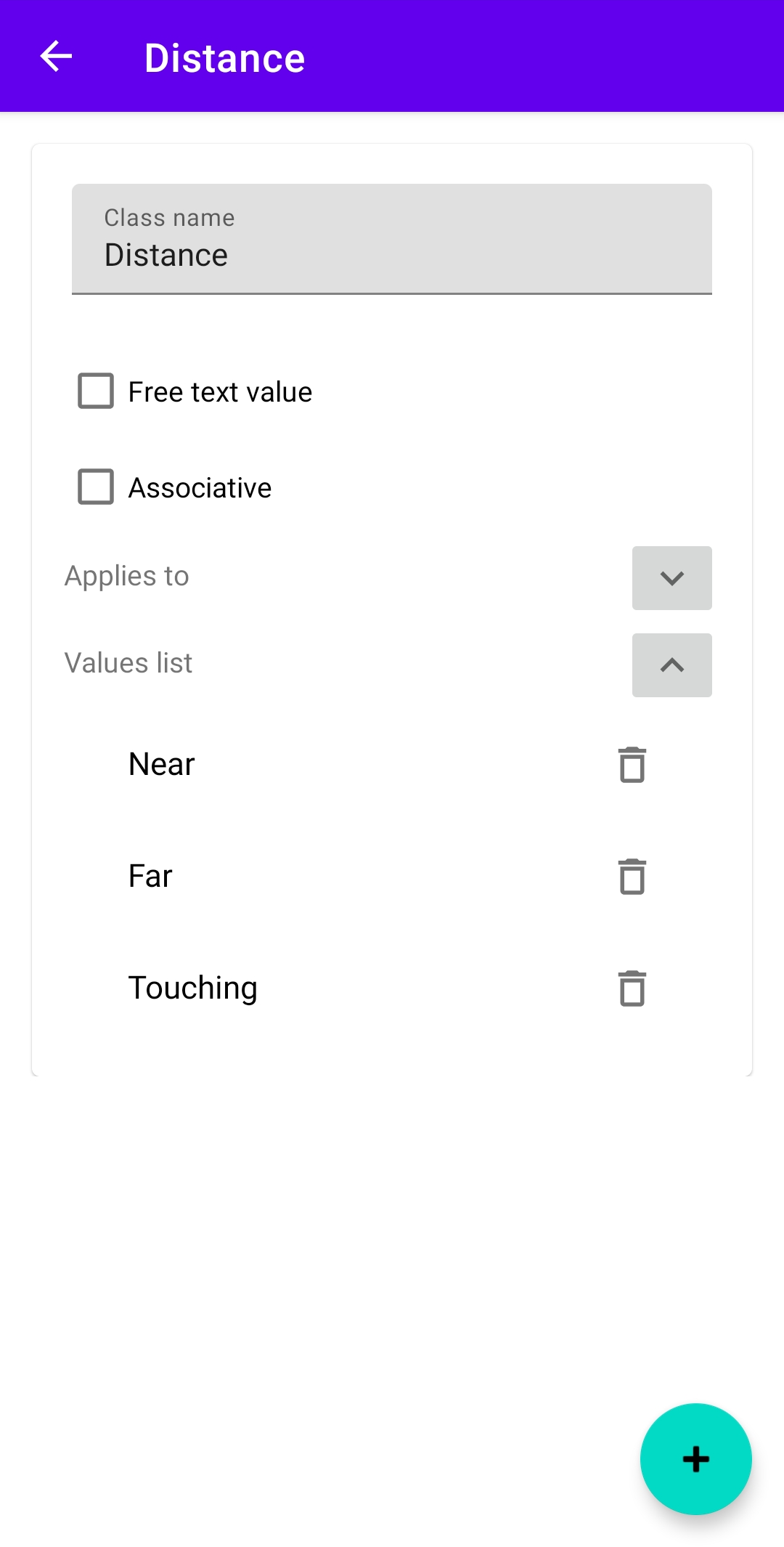
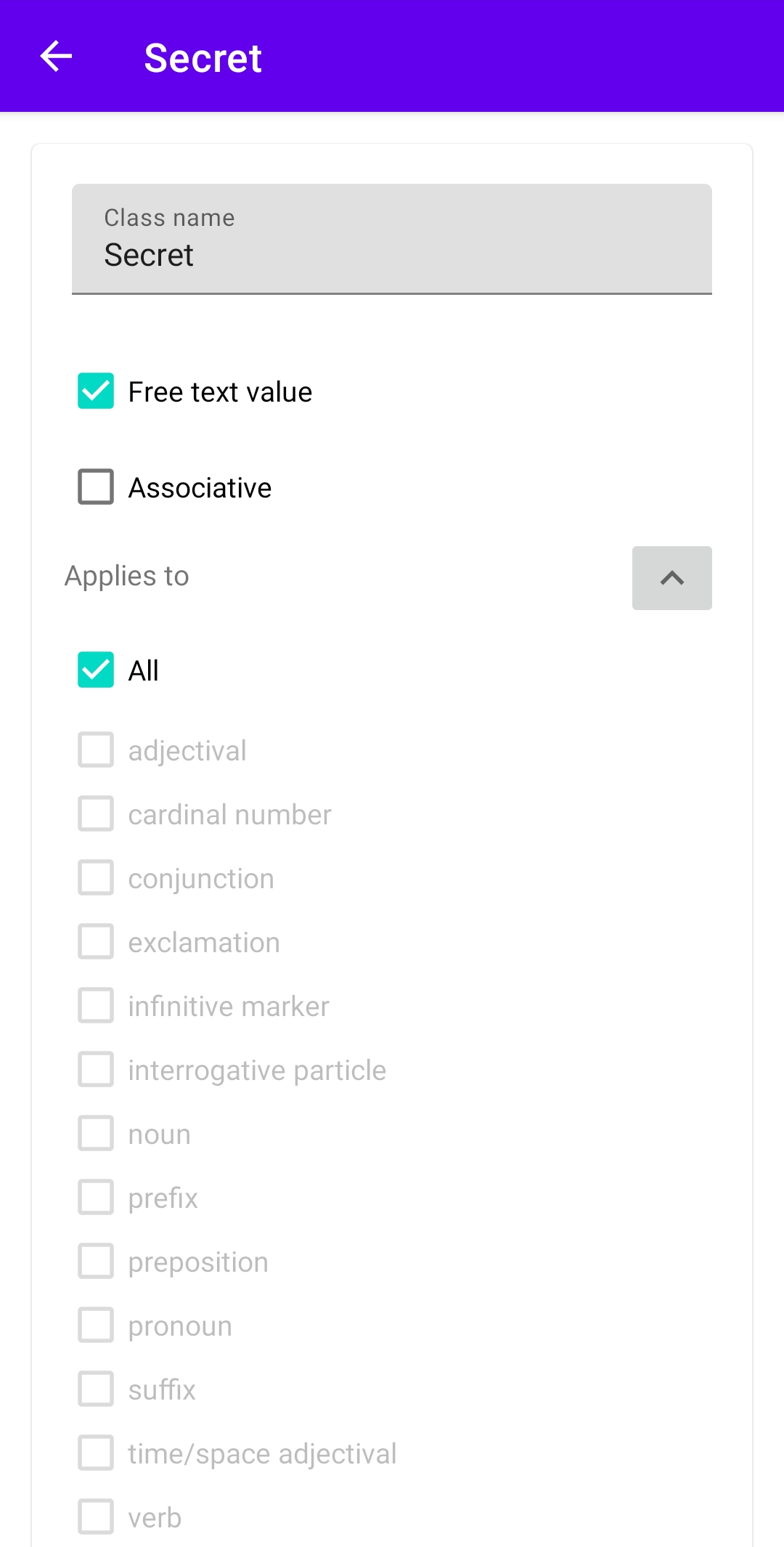
Class name
The name to identify this class. -
Free text value
Makes this class to have a text box instead of a select from a list of values.
This disables the "Values list" section below and the "Add value" button. -
Associative
Makes this class to be a link with another word in your lexicon.
This disables the "Values list" section below and the "Add value" button. -
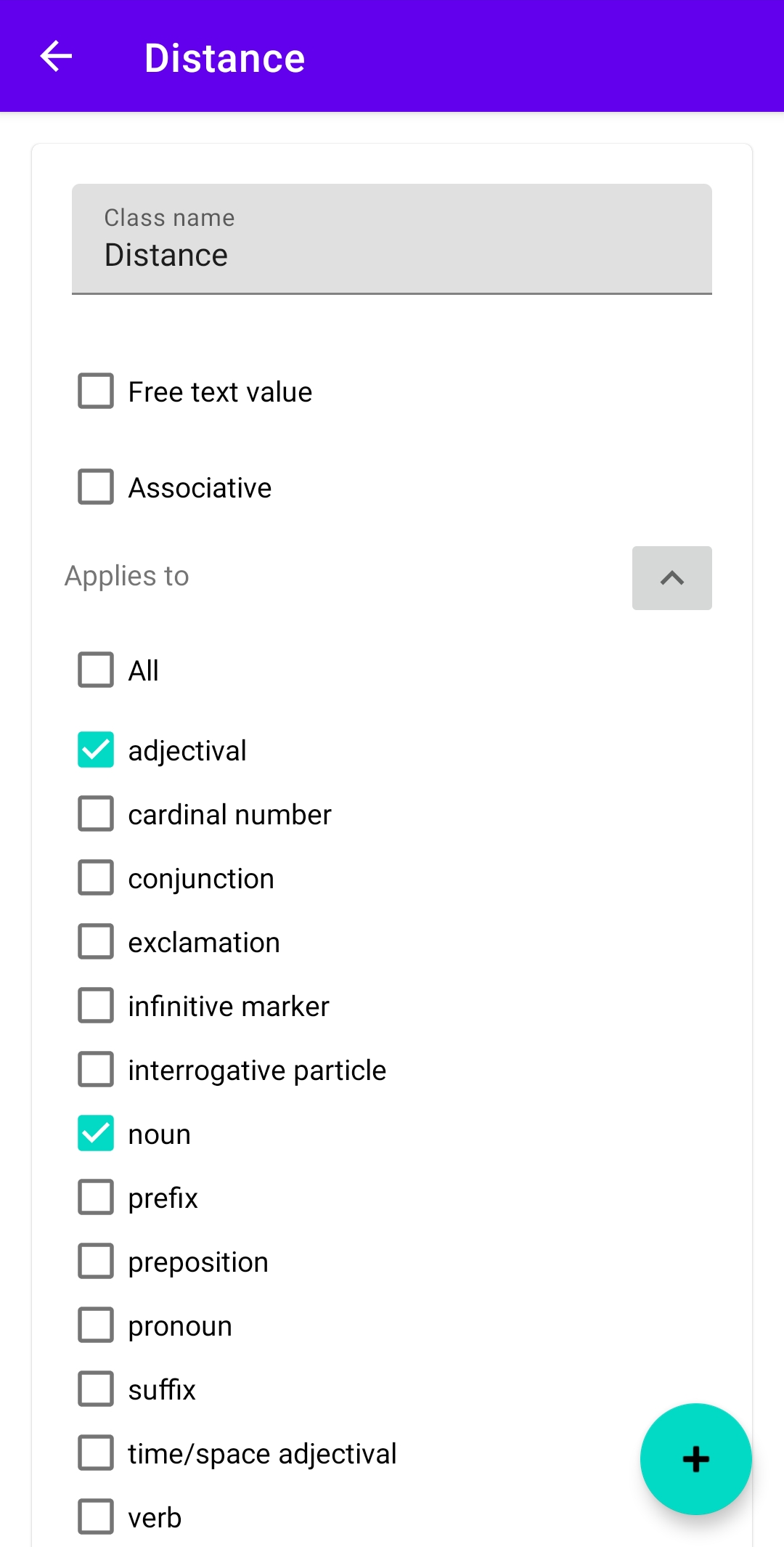
Applies to
List of PoS that will have this class available in lexeme info screen. -
Values list
List of values available for this class.
If the class is "Free text" or "Associative" this is unavailable.
Note
A class can only have a list of values, be associative or be free text.
These options are mutually exclusive, only one behavior can be configured at a time.
Applies to
This section lists all the Parts of speech that the language has configured.
The class can be configured to only a few PoS or all of them.
Classes in lexeme info screen
Normal class
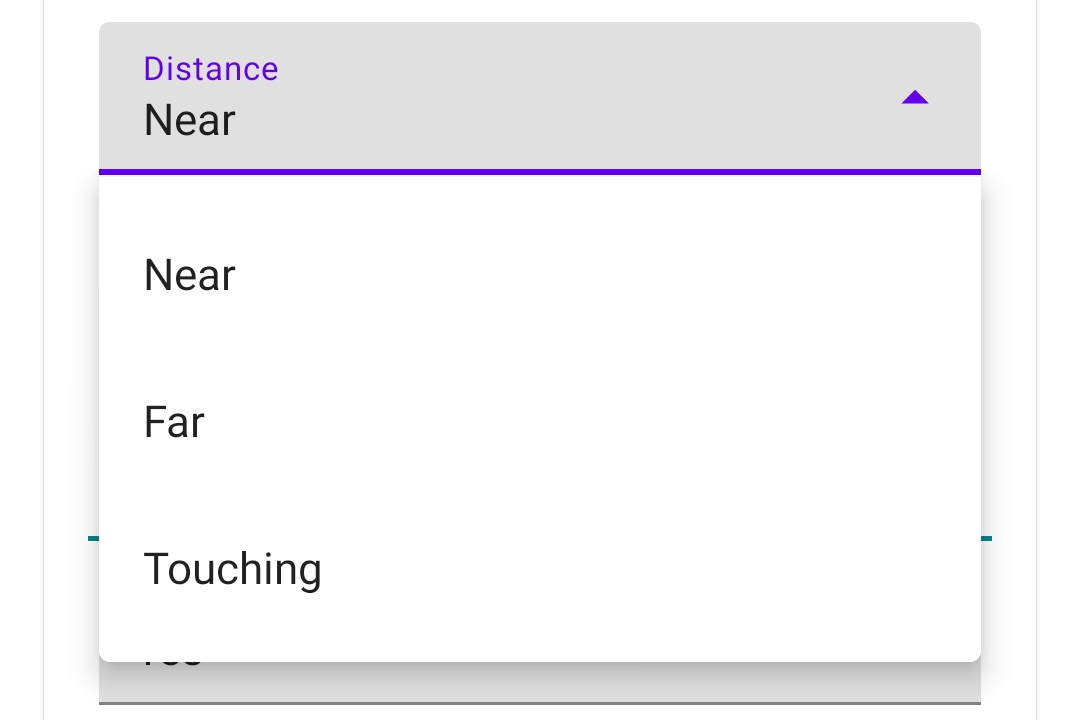
The default behavior of a class is to list the values that had been configured.
Free text class
This type of class gives a field to type any value.

Associative class
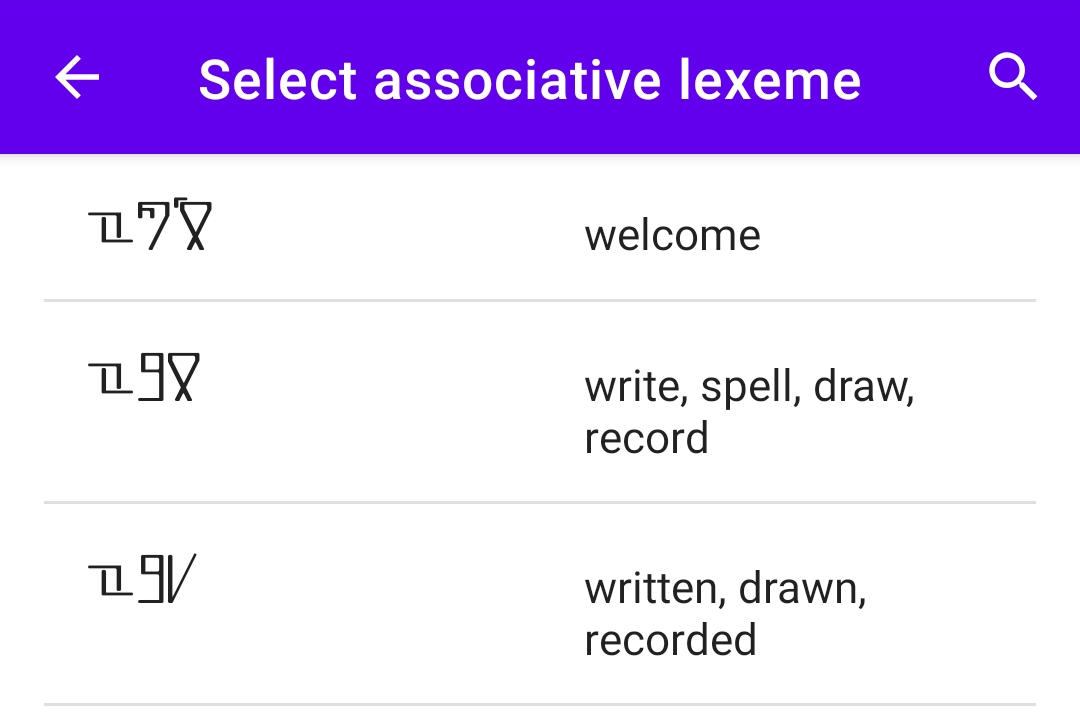
This type of class opens your lexicon to select a lexeme that will show as the value.